
Osteoarthritis is usually managed as a slow, one-directional process of joint wear. The conversation typically centers on activity modification, anti-inflammatories, cortisone and eventually, the prospect of managing pain pharmacologically for the rest of a patient's life. What is rarely discussed is the biological terrain around the joint: the low-grade inflammatory and extracellular matrix conditions that contemporary rheumatology now recognizes as central to how osteoarthritis actually behaves.
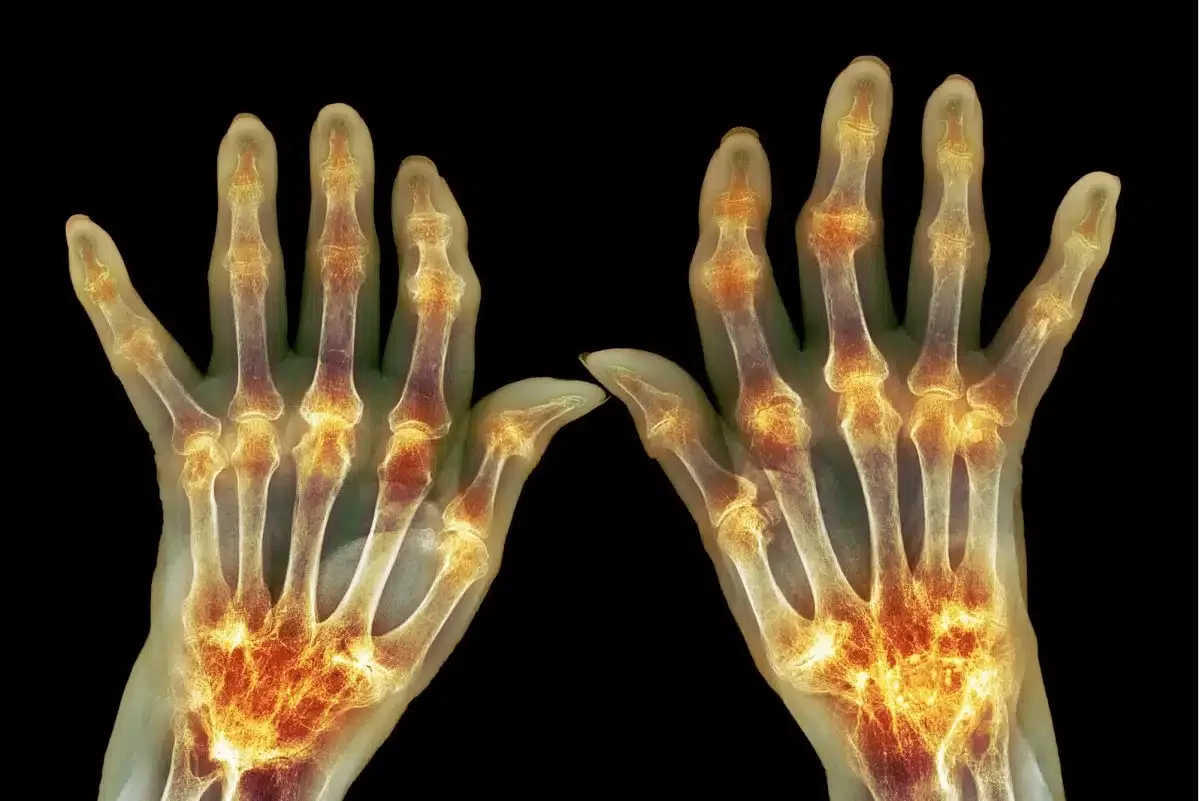
This case documents complete resolution of debilitating, radiographically confirmed hand osteoarthritis pain in a 40-year-old woman using European Biological Medicine drainage therapy, matrix alkalinization, and trace mineral support, with targeted immune and joint drainage remedies added in the second phase. Her self-reported pain fell from 10/10 to complete resolution over approximately three months, and long-standing hip and abdominal pain resolved alongside it. No repeat imaging was obtained; the outcome documented here is symptomatic and functional, not structural.
Patient Profile
A 40-year-old woman presented with severe, debilitating hand pain of four to five years' duration. X-rays had confirmed degenerative changes in the joints of her hands. Her pain was concentrated in the thumbs and the distal joints of the fingers of both hands, and she rated it 10/10 at presentation. She also reported long-standing hip and abdominal pain dating to three prior cesarean deliveries.
The functional impact was concrete: she was unable to buckle her own daughter into a car seat - the pinching, pressing action falling directly on her most affected joints. She reported being told, within her conventional care, that she would likely require steroid medication to manage the pain indefinitely.
No systematic assessment of her elimination capacity, terrain, or the inflammatory milieu around the joints had been part of her prior care.
Naturopathic Assessment: The Terrain Behind the Pain
The joint does not degenerate in isolation. Osteoarthritis was long framed as a purely mechanical "wear-and-tear" condition, but that paradigm has shifted: OA is now understood in mainstream rheumatology as a whole-joint disease in which chronic low-grade inflammation and active remodeling of the extracellular matrix (ECM) are central to pathogenesis. Matrix breakdown products themselves can act as danger signals that activate innate immunity, driving a self-sustaining cycle of inflammation and further matrix degradation. This is the crucial point that makes a terrain approach to OA defensible rather than fanciful: the matrix and its inflammatory environment are not incidental to osteoarthritis - they are part of the disease itself.
In the European Biological Medicine model, this connects to a broader interpretation. Joint symptoms are read as one expression of a congested, acidified extracellular matrix - the fluid environment through which all nutrients, oxygen, and metabolic waste pass between blood and cells. In this patient, several features fit that interpretive picture: a chronic multi-site pain pattern (hands, hip, abdomen) rather than a single mechanical joint; a history of three abdominal surgeries; and a symptom trajectory that had progressed steadily over years. Within Reckeweg's homotoxicological framework, this presentation would be read as a deposition-to-impregnation phase pattern - the terrain, not the cartilage alone, carrying the disorder. I present that framework as the interpretive lens it is, not as a validated diagnostic category: it guided the clinical strategy here, and it remains a model rather than established pathology.
Drainage - Foundational Protocol (Month 1)
Low-dose combination drainage remedies, (brand-Hevert) targeting the primary organs of elimination, each titrated upward from 1 drop to 20 drops twice daily over the first month:
Liver remedy - 1-20 drops 2×/day
Kidney remedy - 1-20 drops 2×/day
Gut remedy - 1-20 drops 2×/day
Lymph remedy - 1-20 drops 2×/day
The multi-pathway approach reflects a core principle of terrain drainage: the downstream routes of elimination - liver, kidney, gut, and lymph - must be open before deeper terrain clearing is attempted. Acute inflammatory healing reactions, known in Homotoxicology as Regressive vicariation, were managed as they came up.
Matrix Alkalinization
Sodium bicarbonate, approximately ¼ teaspoon daily, to address matrix hyperacidity - a foundational European Biological Medicine measure for terrain correction. (This carries a meaningful sodium load and is not appropriate for every patient; caution is warranted in hypertension, heart failure, and renal impairment. In certain cases it is more appropriate to use Potassium bicarb)
Trace Mineral Support
A trace mineral complex at 10 drops twice daily, to provide cofactor support for the enzymatic and detoxification processes that drainage therapy depends upon.
At 30 days, the patient reported approximately 80% improvement in her pain.
Phase Two: Continued Drainage with Targeted Immune and Joint Support (Months 2-3)
The four-organ drainage was maintained at 20 drops twice daily using the Guna drainage remedies, with the trace mineral complex and sodium bicarbonate continued. Two further elements were added:
Targeted immune-modulating pleomorphic remedies (Brand-Pleo Sanum)- intended, within this tradition, to lower systemic inflammation and address chronic infectious terrain.
A joint-specific drainage remedy (Brand-Soluna)
The pleomorphic component belongs to a distinct, second phase of terrain work (ecological and immune rebalancing) that rests on its own rationale largely outside controlled human trials, and this should be acknowledged. Its inclusion also means the outcome cannot be attributed to drainage alone - from month two forward, this was a multi-component protocol.
Outcomes
By the end of the approximately three-month protocol:
Complete resolution of hand pain - from a self-reported 10/10 to functionally absent.
The patient was able to buckle her daughter into the car for the first time with no assistance and no pain.
Long-standing hip and abdominal pain also resolved by her report.
The maintenance plan was supportive drainage one to two times per year for continued support of the ECM and organs of elimination.
These are meaningful, life-changing functional gains. They are also, without exception, patient-reported subjective outcomes, and no repeat imaging was obtained to assess the joint structure itself.
Discussion
The ECM as a rate-limiting environment for joint health. The extracellular matrix is the functional medium through which substances transit between the bloodstream and tissue cells. Contemporary OA research and the ground-regulation model both describe a scenario in which a congested, inflamed matrix sustains local tissue stress -and in osteoarthritis specifically, matrix breakdown products and inflammatory mediators are now understood to perpetuate the disease process. Drainage therapy, by supporting the emunctory organs and facilitating matrix clearance, is aimed directly at that environment rather than at the cartilage surface alone. The mechanistic rationale is coherent; the demonstration that drainage modifies OA is not yet established - a distinction I hold deliberately.
Alkalinization and the inflammatory terrain. Matrix hyperacidity is a central concept in the European Biological Medicine model, and reducing local acid load is a plausible contributor to lowering the inflammatory tone around the joint. I note honestly that, unlike the case of bicarbonate in chronic kidney disease - where controlled human trial evidence exists - there is no comparable trial evidence for bicarbonate in osteoarthritis. The rationale here is mechanistic and traditional, not trial-proven.
The systematic-review literature on homeopathic and combination remedies in osteoarthritis is limited and inconclusive - a small number of trials, some favorable, none definitive. There is no controlled evidence specific to drainage therapy in OA. This intervention sits, honestly tiered, at clinically used but unproven, with the alkalinizing and pleomorphic components more speculative still. What legitimizes reporting the case is not a proven mechanism but the modern, inflammatory understanding of OA that makes the terrain question a serious one.
Limitations. This is a single, uncontrolled case report, and causation cannot be established. Several factors constrain any conclusion: the outcome is entirely patient-reported, with no repeat imaging, so this is resolution of pain, not documented reversal of the arthritis; the protocol was multi-component (drainage, minerals, bicarbonate, pleomorphic remedies, and a joint remedy), so no single agent can be credited; and the well-recognized contributions of placebo response, the therapeutic effect of an attentive clinical relationship, natural symptom fluctuation, and regression to the mean - from a starting point of maximal 10/10 pain - all remain uncontrolled. What the case does document is a clinically coherent trajectory from debilitating, function-limiting joint pain to full symptomatic resolution in a patient whose conventional prognosis was lifelong pharmacologic management. That is sufficient to present it as a clinical observation worthy of attention and formal study.
Clinical Summary
A 40-year-old woman with radiographically confirmed hand osteoarthritis and self-reported 10/10 pain achieved complete resolution of her pain over approximately three months on a drainage-centered naturopathic protocol.
The primary interventions were four-organ oral drainage (liver, kidney, gut, lymph-with Hevert Detox Kit), sodium bicarbonate for matrix alkalinization, and a trace mineral complex, with the GUNA remedies, targeted immune-modulating pleomorphic remedies, and a joint drainage remedy added in the second phase.
The documented outcome is symptomatic and functional, not structural - no repeat imaging was obtained, and this is resolution of pain rather than demonstrated reversal of osteoarthritis.
Contemporary rheumatology's reframing of OA as an inflammatory, matrix-involved whole-joint disease provides a coherent rationale for a terrain-based approach, even as controlled evidence for drainage therapy in OA remains absent.
In patients with debilitating osteoarthritis pain facing a prognosis of indefinite pharmacologic management, terrain-based drainage therapy may warrant consideration and merits formal investigation - as a hypothesis grounded in the modern understanding of the disease, not as a proven cure.
Disclaimer: This article is for educational and informational purposes only and does not constitute medical advice. It describes a single clinical observation and should not be interpreted as a treatment protocol for osteoarthritis or any other condition. The outcomes described are uncontrolled and patient-reported. All patients should remain under the active supervision of a licensed physician. The author does not assume liability for outcomes arising from the application of information contained herein.
Practitioners interested in European Biological Medicine drainage protocols are invited to explore the Foundations of European Drainage course at courses.drmarkiwanicki.com.
Potential clients interested in working together can learn more about my online consults at https://drmarkiwanicki.com/work-with-me
References
Robinson WH, Lepus CM, Wang Q, et al. Low-grade inflammation as a key mediator of the pathogenesis of osteoarthritis. Nat Rev Rheumatol. 2016;12(10):580–592. doi:10.1038/nrrheum.2016.136
Berenbaum F. Osteoarthritis as an inflammatory disease (osteoarthritis is not osteoarthrosis!). Osteoarthritis Cartilage. 2013;21(1):16–21. doi:10.1016/j.joca.2012.11.012
Sokolove J, Lepus CM. Role of inflammation in the pathogenesis of osteoarthritis: latest findings and interpretations. Ther Adv Musculoskelet Dis. 2013;5(2):77–94. doi:10.1177/1759720X12467868
Long L, Ernst E. Homeopathic remedies for the treatment of osteoarthritis: a systematic review. Br Homeopath J. 2001;90(1):37–43. doi:10.1054/homp.1999.0449. PMID:11212088
Brien S, Lachance L, Prescott P, McDermott C, Lewith G. Homeopathy has clinical benefits in rheumatoid arthritis patients attributable to the consultation process but not the remedy: a randomized controlled trial. Rheumatology (Oxford). 2011;50(6):1070–1082. doi:10.1093/rheumatology/keq234. PMID:21076131
Pischinger A. The Extracellular Matrix and Ground Regulation: Basis for a Holistic Biological Medicine. Edited by Hartmut Heine. Berkeley, CA: North Atlantic Books; 2007.